
Certificate of Authenticity of an Artwork: Meaning and Contents
A certificate of authenticity is the reference document that identifies an artwork, supports its provenance and helps preserve its history as it passes from one owner to another.
What is a certificate of authenticity used for?
A certificate of authenticity supports the identification, insurance and future resale of an artwork.
A certificate links the artwork to its artist and records information that remains useful throughout the work’s life. It can support an insurance file, help a gallery or auction professional document a resale and give a collector a clearer record of provenance.
- Establish authorship: it identifies the artist associated with the artwork.
- Support insurability: it can be kept with the invoice and valuation documents.
- Secure future transfers: it follows the artwork rather than a single transaction.
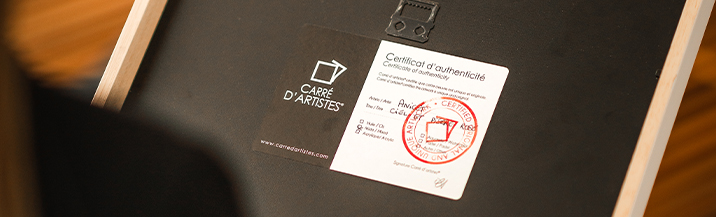
Issued by the gallery, it identifies the artwork, supports traceability and helps preserve its provenance through future transfers.
Who can issue a certificate?
The issuer of a certificate should have a legitimate connection to the artwork and sufficient authority to identify it.
- The artist, as the most direct source of information.
- An estate or rights holder when the artist is no longer living.
- A gallery authorized to represent the artist.
- An auction professional, expert or recognized art historian when appropriate.
Carré d’artistes: for the relevant artworks, the certificate is issued by the gallery and attached directly to the back of the artwork. This creates a lasting physical link between the document and the work.
What should a certificate contain?
The contents of a certificate should be precise enough to identify the artwork without tying it to only one owner or sale.
- The artist’s name.
- The title of the artwork.
- The technique and materials.
- The dimensions and, where relevant, edition information.
- The artist’s signature or the official mark of the issuing gallery.
The sale price belongs on the invoice rather than on a document that follows the artwork. The certificate should describe the work and its provenance, not freeze it to one transaction.
How should you keep the certificate?
Keep the certificate in a dry, safe place and store a digital copy with the invoice and other ownership records.
Do not attach the document permanently to the artwork or expose it to humidity and direct sunlight. Keep the original flat and protected, and save a clear digital copy so that it can be found quickly for insurance, resale or identification.
How can a certificate be made more secure?
A secure certificate combines a reliable issuer with a document that is difficult to reproduce and physically connected to the artwork.
- Secure paper or a document with features that are difficult to reproduce.
- A physical attachment linking the certificate to the artwork.
- An official stamp or embossed mark from the issuing gallery.
- A verification code or digital record when available.
Discover unique and certified artworks
Explore original artworks by more than 500 artists online and in Carré d’artistes galleries.
View artworksFrequently asked questions
Certificate of authenticity questions are answered below in a practical, international context.
Is a certificate of authenticity required when selling an artwork?
Requirements vary by country and transaction. Even when a certificate is not legally required in every situation, it remains an important document for identification, provenance, insurance and resale.
What does a certificate of authenticity contain?
It generally identifies the artist, title, technique, dimensions and issuing professional or gallery. The sale price and the name of a single owner do not normally belong on a document that follows the artwork.
What should I do if I lose the certificate?
Contact the issuing gallery or artist first. Keep your invoice, photographs, provenance documents and any valuation records so that the artwork can still be documented.
Does Carré d’artistes issue a certificate?
Yes. For the relevant Carré d’artistes artworks, the certificate is issued by the gallery and attached to the back of the artwork.
How should I store the certificate?
Keep it in a dry, safe place and store a digital copy with the invoice. Do not expose it to humidity, sunlight or unnecessary handling.
Continue with the guides most relevant to collecting and buying art.