
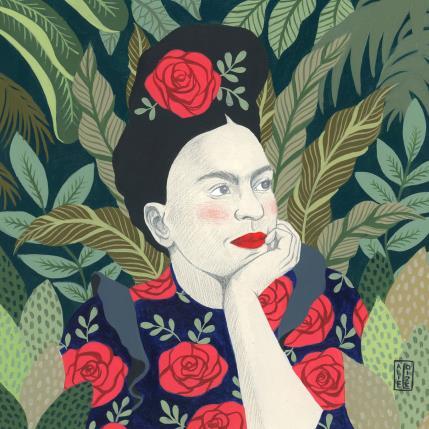
Alie Loizel
Frida #2
25 x 25 cmUSD 480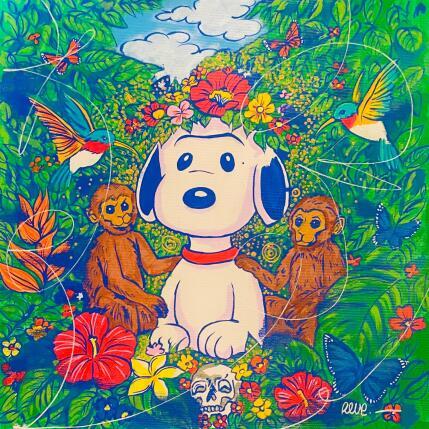
Revel
Snoopy X Frida 2
36 x 36 cmUSD 770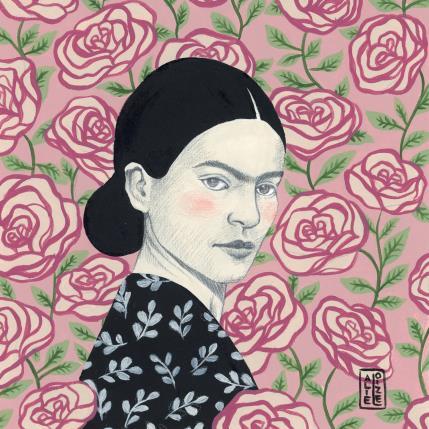
Alie Loizel
Frida#4
19 x 19 cmUSD 290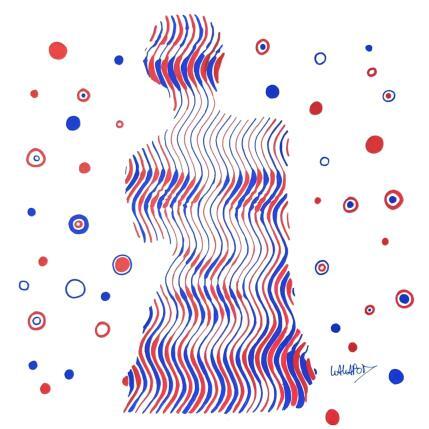
Wawapod
Vénus de Frida bleu rouge
36 x 36 cmUSD 770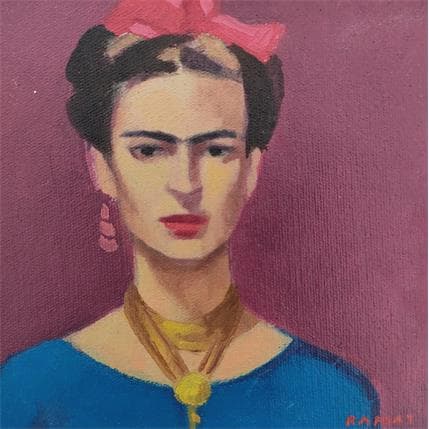
Ramat Manuel
Frida
13 x 13 cmUSD 190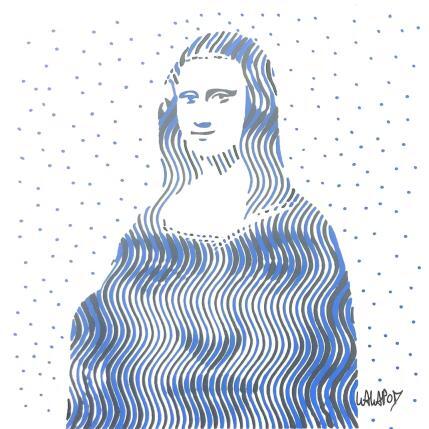
Wawapod
Mona Frida bleu noir
25 x 25 cmUSD 480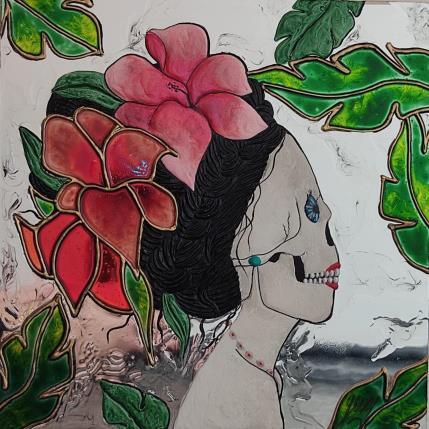
Geiry
Frida
19 x 19 cmUSD 290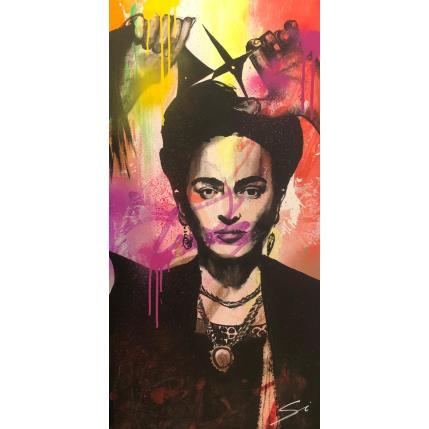
Mestres Sergi
Frida
50 x 100 cmUSD 2,630

The 5 emblematic paintings of the greatest Mexican painter Frida Kahlo
You've heard of this artist, but you're not sure what her paintings are about?
Here are explanations and anecdotes on 5 emblematic paintings of Kahlo, to become unaware of her paintings and understand the hidden meaning of her works.
#1 Self-portrait with thorn necklace and hummingbird, 1940
The painting Frida Kahlo named "Self-portrait with thorn necklace and hummingbird", made in 1940, is one of the most famous paintings of the artist.
This major work depicts the artist from the front, surrounded by a monkey on her right and a black cat on her left.
She is wearing a necklace of thorns that pierce her neck and draw a few drops of blood, where a dead hummingbird is hanging.
The artist is dressed in traditional Mexican attire.
The painting is in the collections of the Museum of Fine Arts in Boston.
This major work depicts the artist from the front, surrounded by a monkey on her right and a black cat on her left.
She is wearing a necklace of thorns that pierce her neck and draw a few drops of blood, where a dead hummingbird is hanging.
The artist is dressed in traditional Mexican attire.
The painting is in the collections of the Museum of Fine Arts in Boston.
What does this painting mean?
Frida wanted to represent the pain she felt after her separation from the painter Diego Rivera.
The two artists divorced in 1938 and remarried in December 1940.
This divorce was very difficult for Kahlo, who painted several paintings on the theme of love's tear.
The hummingbird (dead) represents luck, definitely lost. The black cat, a sign of bad luck, tries to catch the bird, to eat it or hurt it further. While the monkey, in Christian symbolism, is associated with the devil.
The artist represents her ex-husband, Diego, through the primate that is tying the necklace of thorns around her neck, in an attitude of indifference to the pain she feels.
#2 The Two Fridas Kahlo
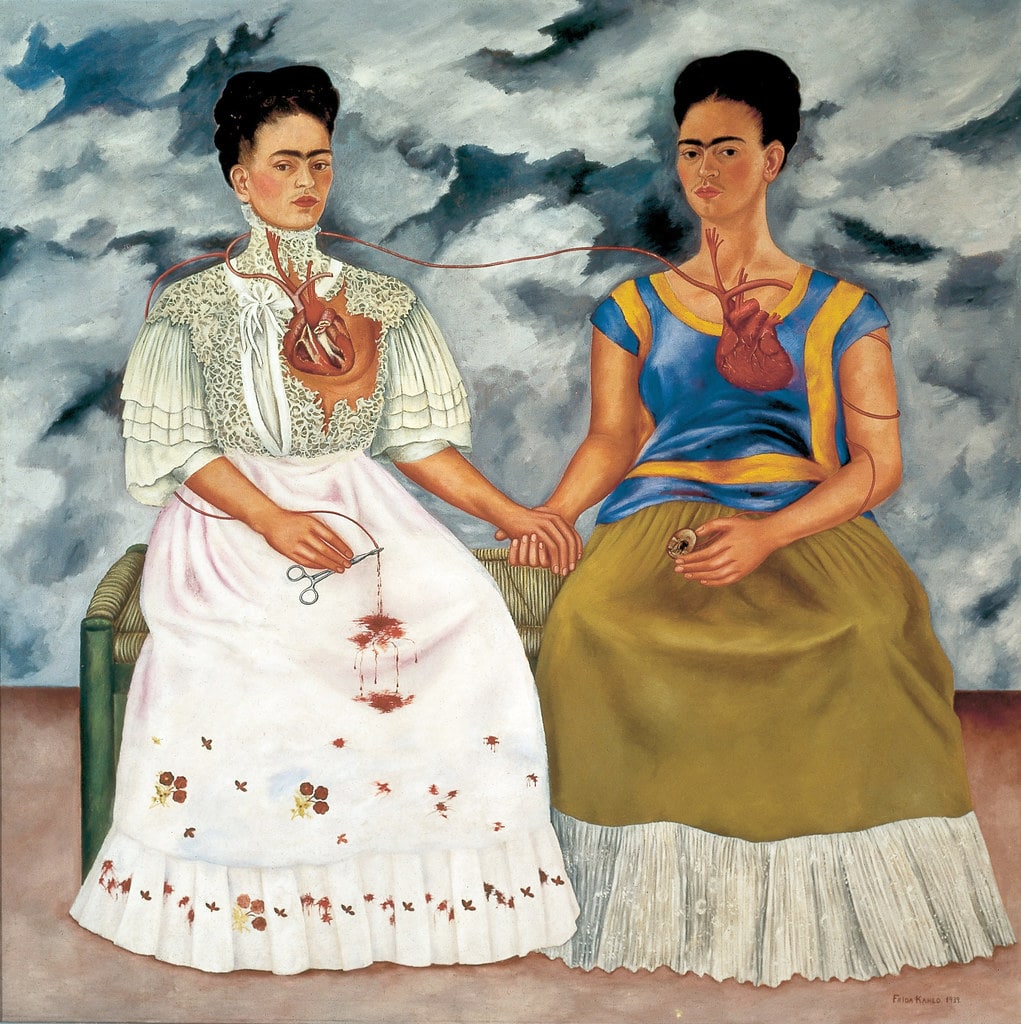
"The Two Fridas" or "Double Self-Portrait" is a painting made in 1939, following her separation from her husband Diego Rivera.
Kahlo lived very badly this separation which plunged her into a profound disarray.
In this painting Frida Kahlo represents two Fridas who are holding hands, but who do not have the same attitude or the same physical appearance.
On the left, the artist is elegantly dressed in a traditional white dress, similar to a wedding dress.
She is wearing makeup and is standing up straight. On her chest, we can see her heart, exposed out of her body by a tear, with two veins visible.
The dress is stained with blood from a vein.
On the right, the artist is dressed in a Tehuana, a traditional Mexican dress.
Her face is colored, without any makeup.
She adopts a masculine look by her position (legs spread) and with a visible mustache.
Her heart is intact. An artery connects the two Fridas, where the one on the left is kept alive by the one on the right.
This painting is an attempt to reconnect and reconcile the artist with herself following her breakup.
Kahlo lived very badly this separation which plunged her into a profound disarray.
In this painting Frida Kahlo represents two Fridas who are holding hands, but who do not have the same attitude or the same physical appearance.
On the left, the artist is elegantly dressed in a traditional white dress, similar to a wedding dress.
She is wearing makeup and is standing up straight. On her chest, we can see her heart, exposed out of her body by a tear, with two veins visible.
The dress is stained with blood from a vein.
On the right, the artist is dressed in a Tehuana, a traditional Mexican dress.
Her face is colored, without any makeup.
She adopts a masculine look by her position (legs spread) and with a visible mustache.
Her heart is intact. An artery connects the two Fridas, where the one on the left is kept alive by the one on the right.
This painting is an attempt to reconnect and reconcile the artist with herself following her breakup.
#3 Self-Portrait on the Mexican-American Border, 1932
This 1932 painting is a must-see in the work of the Mexican artist.
In this beautiful painting Frida Kahlo represents her personal life and experiences.
In 1930, Frida followed her husband to the United States, to San Francisco, to paint murals.
Unlike him, she did not appreciate the American atmosphere and way of life, whose habits and customs were too far removed from her culture.
This painting represents the artist's disgust and weariness for the United States. She represents herself between the two countries, Mexico on the left and the United States on the right. On the side of the United States, we see the Ford factory in River Rouge, symbol of industrialization, the American flag in the middle of the smoke of the factories, buildings and symbols of technical and modern evolution.
The earth seems barren, dried up and the roots of the plants are replaced by electric cables.
On the left, the artist represents Mexico, his native country. Nature is flourishing and symbols of ancient Mexico, ruins and Aztec objects can be seen. The artist stands between the two worlds and holds a Mexican flag, to signify his strong attachment to his roots.
#4 The Broken Column, 1944
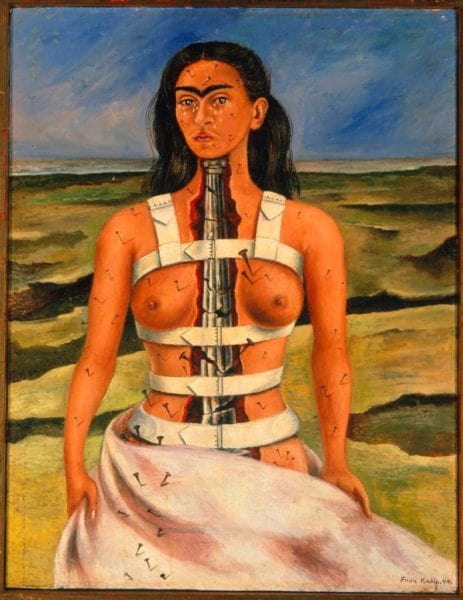
The painting "The Broken Column" was done in 1944. This self-portrait shows the artist in front, standing in the middle of an arid and barren landscape, his bare chest held tight by a white corset. The impression is disturbing and the painting is hard to look at.
The artist's body is strewn with numerous nails, opened in two to reveal a spine made of steel and broken in several places. Large tears flow from Kahlo's eyes, as her gaze is fixed on the viewer.
Among Kahlo's many self-portraits, this one is particularly strong and moving.
The pain that emanates from the work is palpable, while at the same time one discerns the strength and pride that allow the artist to hold on.
This work echoes the bus accident that occurred in 1925, when the artist was only 18 years old, and which left him with serious after-effects for the rest of his life. Although the work is full of symbols, Kahlo defends herself from being a surrealist: she does not paint dreams, she paints her life and her personal experiences, those of a suffering and broken woman who can only fight to live.
#5 The Wounded Deer, 1946
This small painting entitled "The Wounded Deer" was created in 1946 by Frida Kahlo.The painting measures only 22.5 x 30 cm. The atmosphere created is strange, almost fantastic and intimate. There is a visual exchange with the deer, whose body is faithfully reproduced, but whose facial features are those of the artist, and who stares at the viewer from the front in a stoic attitude.
The artist's face is easily recognizable, with thick eyebrows, eyes and very brown hair. The deer is wounded by several arrows that pierce its back and chest. He is in the middle of a frightening wood, alone with his pain.
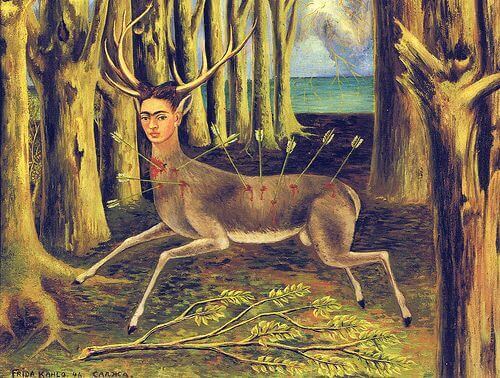
In this painting Frida Kahlo represents the surgery she underwent that same year in New York, in an attempt to alleviate her back pain (following her serious accident in 1925).
Convinced that the pain would stop after the operation, Frida is depressed when she realizes that the operation has failed and the pain returns. This painting represents the artist's physical and psychological distress and suffering as she realizes that nothing can ever relieve
her.
INSPIRATION FRIDA KAHLO BY CARRE D'ARTISTES
True fan of Frida Kahlo? This collection is made for you! Carré d'artistes unveils an exclusive collection inspired by the artworks of the Mexican artist.Browse through our unique and certified works by our French and international painters!
Do not miss a favorite, each unique work is the knowledge of an artist, it does not hesitate a second as yours in the world.
Unfortunately a favorite is not duplicated ... then ready to become a collector or art lover?
Read more articles about Frida Kahlo :
🎨 ¡ Viva el arte ! : paintings inspired by Frida Kahlo
🎨 Frida Kahlo: artistic current and painting style
🎨 Frida Kahlo's influence today
🎨 Discovering Frida Kahlo
🎨 Top 10 things to know about the artist Frida Kahlo
Do not miss a favorite, each unique work is the knowledge of an artist, it does not hesitate a second as yours in the world.
Unfortunately a favorite is not duplicated ... then ready to become a collector or art lover?
Read more articles about Frida Kahlo :
🎨 ¡ Viva el arte ! : paintings inspired by Frida Kahlo
🎨 Frida Kahlo: artistic current and painting style
🎨 Frida Kahlo's influence today
🎨 Discovering Frida Kahlo
🎨 Top 10 things to know about the artist Frida Kahlo